
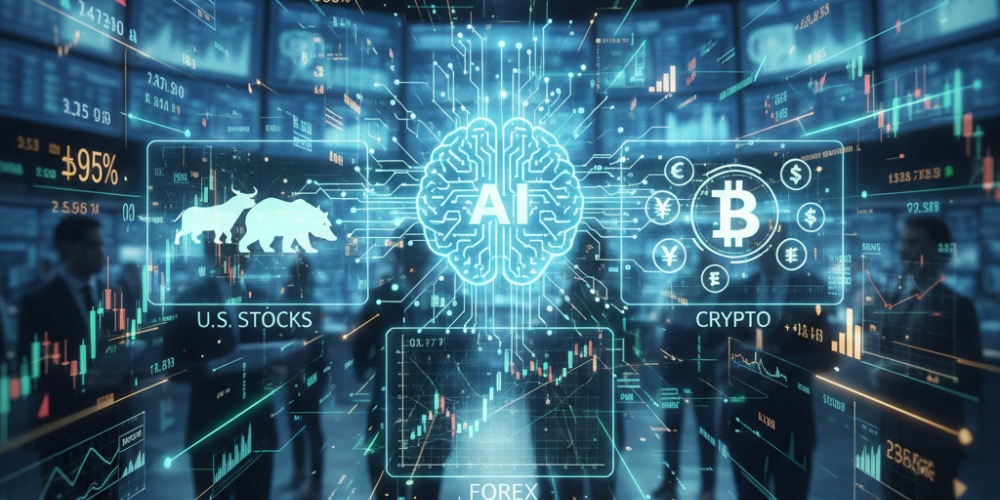
From machine-learned signals and sentiment-driven strategies to live execution engines, AI is reshaping how market participants discover and act on opportunities. Here’s a practical, regulator-aware guide for traders, quants, and portfolio teams who want to use AI responsibly across stocks, forex and crypto.
Lead — the new frontier in trading
Artificial intelligence is no longer a niche experiment in finance. Today’s AI-driven trading systems combine statistical models, deep learning, and — increasingly — large language models (LLMs) to mine data, generate signals, and help execute trades across U.S. equities, foreign exchange markets and digital assets. Firms large and small are using these tools to speed research, extract signals from unstructured information (news, filings, social media) and automate routine decisions — but regulators and risk managers are watching closely.
What “AI-driven trading” actually means
At a basic level, an AI-driven trading system has four moving parts:
- Data ingestion: market data, order books, news, alternative datasets (satellite, credit-card flows, social sentiment).
- Signal generation: models — from classical statistical models to deep learning (LSTMs, Transformers, NHITS) — that forecast price movement, volatility, or liquidity.
- Decision logic & portfolio construction: risk constraints, position sizing, portfolio optimization.
- Execution & monitoring: APIs, smart order routers and execution algorithms to minimize slippage and market impact (and to comply with trading rules).
This pipeline is similar in all asset classes, but the inputs, time horizons and liquidity constraints differ (explained below).
Stocks: structured data + unstructured text = new alpha sources
U.S. equities benefit from massive amounts of structured data (prices, fundamentals) and a steady stream of regulatory filings and news. LLMs and specialized financial NLP models are now used to turn 10-Ks, earnings calls and analyst notes into quantifiable signals (sentiment, surprise, risk themes). Peer-reviewed reviews and industry syntheses show a rapid rise in research that applies LLMs to equity markets.
Opportunities: faster idea discovery, event-driven signals (earnings, guidance), sentiment-based short-term signals, and portfolio-level augmentation of traditional quant factors.
Constraints: corporate disclosures can be noisy; data leakage and overfitting remain real risks. Backtest rigor and out-of-sample validation are essential.
Also read: Top 10 Blockchain Trends to Watch in 2026 and Beyond
Forex: latency, regime shifts and structural signals
The FX market is extremely liquid and sensitive to macro flows, news and central-bank moves. AI models can help detect regime shifts and translate macro communication into trading impulses, but they must handle:
- High-frequency microstructure for short-horizon strategies.
- Macro regime detection for medium-term carry or carry-risk strategies.
- Robustness to exogenous shocks (policy, geopolitical events).
Because FX is so large and automated already, durable edges often come from superior risk modelling, cheaper execution, or unique alternative datasets rather than raw model complexity.
Crypto: rapid innovation, high volatility, and novel datasets
Crypto markets combine deep volatility, 24/7 trading and on-chain signal availability. AI systems can analyze on-chain metrics (wallet flows, liquidity pools), developer activity, and social trends to build signals unavailable in traditional markets. But the space has unique operational and regulatory risks.
Opportunities: novel on-chain features (balance changes, protocol metrics), arbitrage across venues, and event-driven plays around protocol upgrades.
Constraints: exchange custody risk, fragmented liquidity, and fast regulatory developments.
Tools & platforms — how teams build and deploy
Practitioners use a mix of open-source stacks and commercial platforms. Popular building blocks include backtesting engines and cloud APIs such as QuantConnect (LEAN), Alpaca and institutional execution systems — each offers tradeoffs in data access, latency, and asset coverage. For prototyping, Python-first APIs and cloud backtests speed iteration; for production, latency and robust monitoring become priorities.
Real risks you must manage
- Model risk & overfitting: models that work in backtests may fail live without robust validation.
- Data and “AI-washing”: regulators have penalized firms for misleading AI claims; transparency about model scope and limitations is critical. (SEC)
- Operational & execution risk: failed orders, system outages, and market-impact mistakes.
- Regulatory scrutiny: the SEC and other agencies are actively considering rules and guidance for predictive analytics and AI use by broker-dealers and advisers; firms should plan for disclosure and compliance.
- Adversarial and tail events: AI models can be brittle under stressed market conditions — stress testing and conservative risk limits are necessary.
The regulatory landscape — important highlights
Regulators worldwide are moving from observation to rulemaking. In the U.S., the SEC has both pursued enforcement actions for misleading AI claims and proposed rule changes around the use of predictive data analytics by broker-dealers and advisers; that trend means disclosure, governance and conflict-of-interest controls are rising priorities for firms that rely on AI. European regulators and supervisors (e.g., ESMA) are also publishing guidance on LLMs and finance. Plan for stronger documentation, audit trails and human oversight.
Best practices for building an AI trading system (practical checklist)
- Start with data hygiene: timestamp integrity, survivorship bias checks, and clean feature pipelines.
- Strong backtest methodology: walk-forward tests, cross-validation, transaction cost modelling.
- Model explainability & monitoring: keep human-readable explanations for signals, and monitor model drift.
- Execution-aware design: integrate slippage, latency and venue fragmentation into simulations.
- Regulatory & compliance design: disclosure templates, governance ladders, and incident playbooks.
A simple roadmap for traders & small teams
- Experiment: start with paper trading on a platform like Alpaca or QuantConnect to validate ideas quickly.
- Scale carefully: move winners behind execution algorithms and robust risk controls.
- Governance: implement audit trails, model cards and signoffs before live money.
- Iterate: use real-time performance and stress tests to evolve models.
Where AI currently helps most (and where it doesn’t)
Helps most: processing unstructured data (earnings calls, news), signal enrichment, efficiency gains in research, and automating low-value tasks.
Helps less: guaranteeing persistent outperformance — markets adapt, and many published “edges” decay when scaled.
Responsible use: avoid the hype
Regulators are actively penalizing inaccurate marketing around AI. Firms must avoid “AI washing” — overstating capabilities — and must be ready to demonstrate how models were validated and monitored. Clear client communication, robust documentation, and conservative marketing are practical necessities.
Bottom line
AI-driven trading systems open new pathways to analyze data and automate decision workflows across U.S. stocks, forex and crypto. They can accelerate research, help harvest alternative signals and improve operational efficiency — but they are not magic. Strong engineering, disciplined validation, clear governance and regulatory awareness are the difference between a useful tool and an uncontrolled risk. If you’re building or adopting AI for trading, make it measurable, auditable and incremental.
FAQ
Can AI guarantee profits in stocks, forex, or crypto?
No. AI can improve signal discovery and decision support, but it cannot guarantee profits. Markets change, and models can fail in new regimes. Rigorous testing, risk limits and continuous monitoring are essential.
Are there off-the-shelf AI trading bots I can trust?
There are commercial platforms and open frameworks for prototyping, but “trust” depends on transparency, testing and the provider’s track record. Avoid services that make bold, unverified performance claims — regulators have fined firms for misleading AI statements.
Is using LLMs for trading legal?
Using LLMs is legal, but it raises the same regulatory responsibilities as other analytics: fair dealing, accurate disclosures, conflict management and data-protection obligations. Some proposals and guidance focus specifically on predictive analytics and AI use by investment firms.
Which platforms are good for prototyping?
QuantConnect and Alpaca are widely used for prototyping and paper trading; choice depends on asset coverage, data needs, and whether you need low-latency execution.
How should a small trading team start?
Begin with a narrow problem, use high-quality historical data, backtest with realistic transaction costs, paper-trade, and add governance controls before deploying capital.