Traders trade charts. Investors study fundamentals. But the market that moves fastest is human emotion — and the Crypto Fear and Greed Index is one of the clearest gauges we have of that mood. From headlines to buy-the-dip tweets, this single 0–100 number has become a staple on trader dashboards and news tickers. Here’s a practical, journalist-style guide to what the index measures, how it’s built, why people use it — and where it falls short.
What the Crypto Fear and Greed Index is (and what the numbers mean)
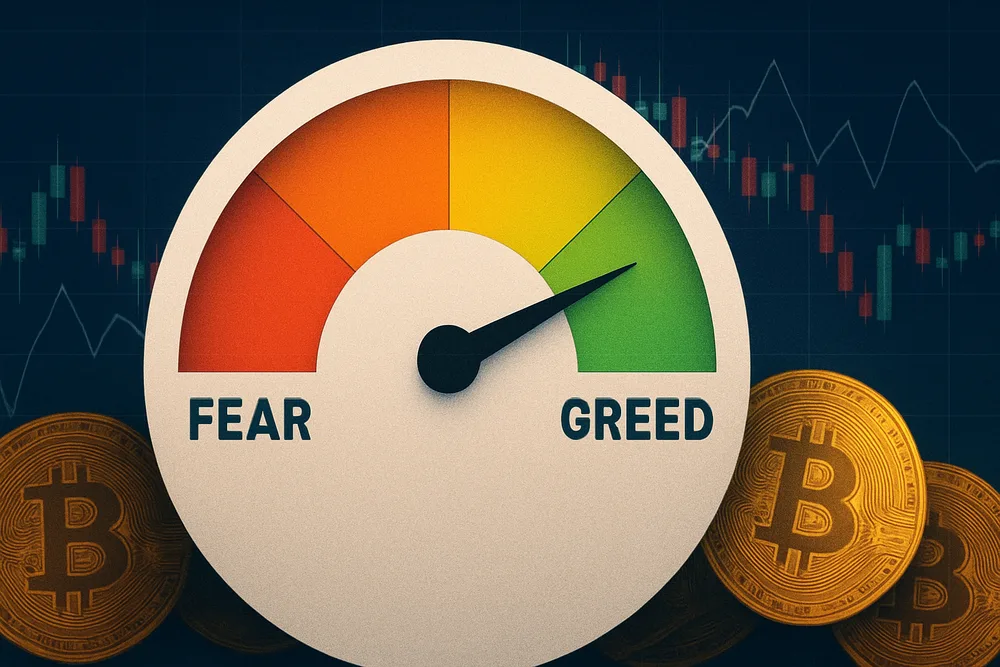
The Crypto Fear and Greed Index compresses market sentiment into a single daily value from 0 (Extreme Fear) to 100 (Extreme Greed). Lower readings indicate widespread worry — sometimes signaling oversold conditions — while higher readings point to froth and possible overvaluation. Many traders treat the index as a contrarian tool: extreme fear can be a buying opportunity, extreme greed a warning sign.
Also read: Zero-Knowledge Proofs: How a Breakthrough Cryptography Method Is Reshaping the Future of Crypto
How the index is calculated (the bones under the hood)
The most widely referenced crypto index (run by Alternative.me) combines multiple data streams into one number. The components and their published weights are:
- Volatility (25%) — recent bitcoin volatility and drawdowns versus 30-/90-day averages. Unusually high volatility pushes the index toward “fear.”
- Market momentum & volume (25%) — whether inflows and price momentum are strong (greed) or weak (fear).
- Social media (15%) — speed and volume of mentions and interactions on platforms like Twitter. A spike in social traffic often signals FOMO.
- Surveys (15%) — community polls (not always active). When available, they add a direct read of investor mood.
- Dominance (10%) — Bitcoin’s share of the total crypto market cap; rising dominance often corresponds to risk-off moves.
- Trends (10%) — Google Trends and related search behavior for Bitcoin-related queries.
Alternative.me publishes the methodology and updates the index daily, and other platforms (CoinMarketCap, Binance, CoinDesk and exchanges) offer similar fear/greed widgets or their own proprietary sentiment metrics.
Also read: Top Crypto Exchange and Wallet Apps in the US
Why traders and journalists care
- It’s intuitive. A single number is easy to read and acts as a quick “mood” check for BTC and the broader crypto market.
- Contrarian signal. Many retail traders use low readings as a prompt to “buy the dip” and high readings to take profits — a classic contrarian approach.
- Context for headlines. When newsrooms report “extreme fear” or “extreme greed,” they’re usually citing the index — which helps readers translate emotion into possible market behavior.
Strengths: fast, data-driven, widely followed
- Timely daily updates make it useful for short-term traders and journalists tracking sentiment swings.
- Multi-source inputs (price action, volume, social signals, trends) give it broader coverage than pure-price indicators.
Limits and common criticisms
The index is helpful — but not a crystal ball. Key limitations include:
- Bitcoin bias. The standard index is heavily BTC-centric, so it may miss nuanced altcoin cycles.
- Overreliance on surface signals. Social buzz and search spikes can be gamed or reflect headline noise rather than durable conviction.
- Short history for rigorous backtesting. Researchers note that sentiment indexes can correlate with returns, but causality and predictive power vary by period. Recent academic work urges caution when using sentiment metrics as deterministic signals.
- Different vendors, different numbers. CoinMarketCap, Binance and other providers publish their own fear/greed or sentiment tools; values may differ based on inputs and weighting. Don’t assume every “fear and greed” badge is identical.
Also read: Top 10 Blockchain Trends to Watch in 2026 and Beyond
How professional traders actually use it (practical playbook)
- Confirm, don’t trade on it alone. Use the index alongside volume analysis, moving averages (e.g., 50/200 MA), and risk management rules.
- Scale entries and exits. A low fear score might trigger a staggered buy plan rather than an all-in trade; high greed can be a cue to trim risk.
- Watch divergence. If price is rising but fear/greed weakens (or vice versa), that divergence can hint at weakening momentum.
Where sentiment indicators fit in the broader toolkit
Sentiment tools like the Crypto Fear and Greed Index are psychological indicators — they’re most useful when combined with technical indicators (RSI, MACD), on-chain metrics (active addresses, flows) and macro context (interest rates, regulatory news). For example, a surge in fear during a macro shock may reflect systemic issues rather than a simple “buy the dip” opportunity.
Also read: Smart Ways to Earn Money Through Real-World Asset (RWA) Tokenization in Real Estate and Gold
FAQ
What is a “good” Fear and Greed score for buying Bitcoin?
There’s no universal “good” score, but many traders consider readings in 0–24 (Extreme Fear) as potential buying windows and 75–100 (Extreme Greed) as times to reassess risk. Always pair sentiment with technical and on-chain checks.
Is the Crypto Fear and Greed Index the same as the VIX?
No. The VIX measures implied volatility in S&P 500 options. The Crypto Fear and Greed Index aggregates price behavior, volume, social metrics and search trends for crypto markets — they capture different markets and different types of fear.
Who runs the most-cited Crypto Fear and Greed Index?
The commonly cited index is published by Alternative.me; other platforms (CoinMarketCap, Binance, CoinDesk) publish their own sentiment tools. Differences in data sources and weights can create different readings.
Can the index predict price moves?
It’s a sentiment gauge — not a predictive oracle. Academic studies find correlations between sentiment and returns in some periods, but the index should be one input among many and used with disciplined risk management.
How often is the index updated and where can I see it?
Alternative.me updates the Crypto Fear and Greed Index daily and offers historical charts and an API for developers. Several exchanges and data sites also display daily sentiment widgets.
Bottom line
The Crypto Fear and Greed Index is a compact, widely followed thermometer of market emotion. It’s valuable as a quick situational read — especially for retail traders and journalists — but it’s not a substitute for fundamentals, risk controls, or careful analysis. Treat it like a sixth sense: useful for prompting questions and checks, not for making single-signal trading decisions.