
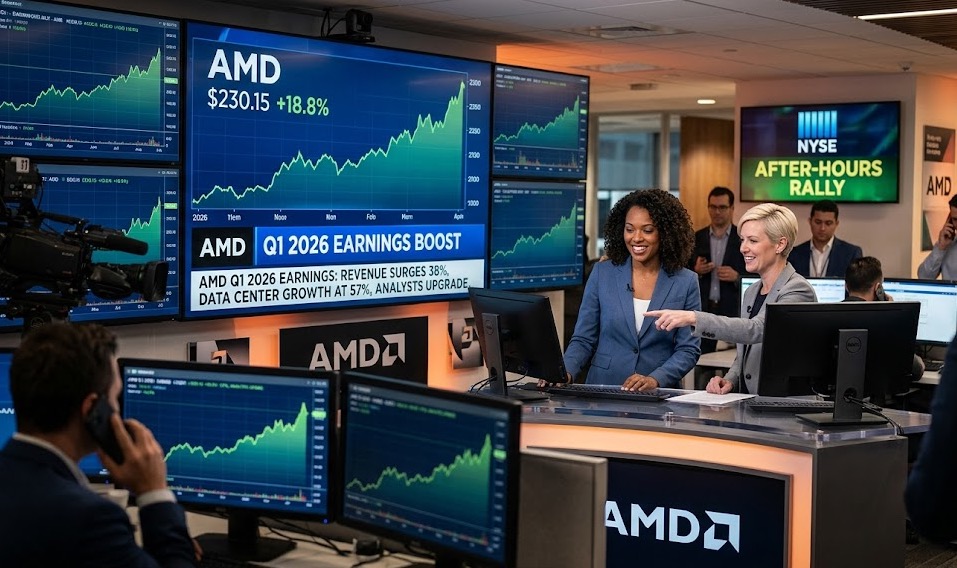
Advanced Micro Devices (AMD) has firmly cemented its position at the forefront of the artificial intelligence revolution, delivering a monumental first-quarter earnings report for 2026 that sent shockwaves through the financial markets. Following a blistering run earlier in the year, the semiconductor giant has successfully translated bullish sentiment into spectacular fundamental results. Driven by surging demand for AI infrastructure and remarkable growth in its data center segment, AMD shares experienced their best post-earnings gain in seven years. With major upgrades from heavyweights like Goldman Sachs, Citi, and Bernstein, the narrative surrounding AMD has unequivocally shifted as the market fully digests the magnitude of the company’s current trajectory.
Financial Performance: Q1 2026 Breaks Expectations
For the first quarter of 2026, AMD reported an outstanding set of financial results that comfortably cleared Wall Street’s hurdles. Total revenue reached $10.25 billion (often rounded to $10.3 billion in company press releases), representing a staggering 38% increase year over year. This figure effortlessly surpassed the analyst consensus estimate of $9.91 billion.
Profitability metrics were equally impressive, proving that AMD is scaling its margins alongside its top-line growth. On a GAAP basis, the company reported a net income of $1.38 billion, which marks a massive 95% surge compared to the same period last year. This was driven higher by an operating margin that expanded by 300 basis points to 14%. Diluted earnings per share (EPS) on a GAAP basis stood at $0.84.
However, the non-GAAP figures paint an even stronger picture of operational efficiency. Adjusted earnings per share surged 43% to $1.37, beating the consensus estimate of $1.29 with room to spare. Non-GAAP gross margin expanded to 55%, while non-GAAP operating income reached an impressive $2.5 billion, and net income landed at $2.3 billion. Jean Hu, AMD’s executive vice president, CFO, and treasurer, highlighted that the results reflect “strong performance across all key financial metrics, with accelerating revenue growth, earnings expansion and record quarterly free cash flow.” She noted that the operating model is demonstrating significant leverage as the company invests for accelerated growth.
The AI Catalyst: 57% Data Center Growth
The undisputed star of AMD’s first-quarter performance was its data center segment. Revenue in this critical division skyrocketed 57% year over year, reaching an impressive $5.8 billion. This surge effectively makes the data center the primary driver of AMD’s overall revenue and earnings growth, shifting the company’s center of gravity entirely toward high-performance enterprise computing.
AMD Chair and CEO Dr. Lisa Su described the quarter as “outstanding,” specifically pointing to the “accelerating demand for AI infrastructure.” The core of this demand centers around AMD’s EPYC CPUs and Instinct GPUs. As enterprise customers scale their artificial intelligence operations, the hardware requirements are becoming increasingly intensive. Dr. Su emphasized, “We are seeing strong momentum as inferencing and agentic AI drive increasing demand for high-performance CPUs and accelerators.”
Looking ahead, AMD expects server growth to accelerate meaningfully as the company scales its supply chain to meet this unprecedented demand. Customer engagement surrounding the highly anticipated MI450 Series and Helios architecture is strengthening rapidly. According to the company, leading customer forecasts are already exceeding initial expectations, and there is a growing pipeline of large-scale deployments that is providing management with increasing visibility into AMD’s long-term growth trajectory.
Wall Street Reacts: Historic Stock Surge and Upgrades
The market’s reaction to AMD’s earnings report was nothing short of historic. Shares soared 18.8% in premarket action and maintained gains of around 15% through the trading session, lifting the company’s market capitalization on track to top $600 billion. This dramatic upward movement marks AMD’s best post-earnings stock performance since January 30, 2019.
Following the report, a wave of major financial institutions scrambled to adjust their models and upgrade the stock. Notable analyst actions include:
- Goldman Sachs: Upgraded AMD from Neutral to Buy, setting a price target of $450.
- Citi: Joined the bullish chorus with an upgrade, contributing to the broader positive momentum on Wall Street.
- Seaport Research Partners: Analyst Jay Goldberg upgraded the stock from Neutral to Buy with a price target of $430.
- Bernstein: Stacy Rasgon upgraded the stock from Market Perform to Outperform, establishing a massive price target of $525.
The sentiment among analysts reflects a profound shift in perspective regarding the semiconductor landscape. Morgan Stanley’s Joseph Moore summarized the mood by stating, “The world has changed.” Investors are now paying significantly more attention to CPU momentum than they had in the recent past.
Jay Goldberg from Seaport Research acknowledged that, in hindsight, recent earnings results from rival Intel were a “very clear signal that AMD’s business was picking up.” While Goldberg previously wanted to wait and see how AMD executed the ramp of its MI450 graphics processing unit before turning bullish, he admitted that “demand for CPUs has pulled up the timeline considerably for earnings.” Furthermore, Goldberg highlighted AMD’s ability to secure more manufacturing capacity from Taiwan Semiconductor Manufacturing (TSM) as a crucial competitive advantage. As demand ripples across the industry, companies with guaranteed access to TSMC’s allocation are positioned to dramatically outperform their peers.
Bernstein’s Stacy Rasgon provided a particularly aggressive outlook following the data center results. Rasgon suggested that AMD could generate more than $14 in adjusted earnings per share in 2027, and nearly $20 by 2028. This is significantly higher than the broader Wall Street consensus, which had previously been modeling less than $12 and less than $16 for those respective years.
Morningstar Valuation and Sector Momentum
According to Morningstar data released on May 6, 2026, AMD’s valuation metrics reflect its premium positioning in the high-growth AI sector. The company’s normalized Price/Earnings (P/E) ratio stands at 86.46, with a Price/Book Value of 9.33 and a Price/Sales ratio of 17.03. When compared to legacy competitor Intel, which carries a normalized P/E of 174.77 and a lower Price/Sales of 8.74, AMD’s metrics highlight a market that is aggressively pricing in its superior growth trajectory and operational execution. In terms of financial strength, AMD boasts a Quick Ratio of 1.78 and a Current Ratio of 2.85, demonstrating a highly liquid balance sheet capable of supporting its massive ongoing investments in AI research, development, and supply chain commitments.
Furthermore, the broader semiconductor sector has experienced massive capital inflows, heavily benefiting from fundamental catalyst reports like AMD’s. Recent financial data highlights that the semiconductor rally lifted April ETF flows to a staggering $167 billion, showing that retail and institutional appetite for AI-exposed equities remains absolutely insatiable.
Challenges and The Broader Infrastructure Landscape
Despite the overwhelming optimism, there are still variables that cautious investors are monitoring closely. The performance of AMD’s GPU business in the second half of the year remains a critical factor. Analysts note that this side of the business is somewhat in a “holding pattern” as customers await the launch of the MI455 accelerator. Morgan Stanley views the upcoming rack-scale launch as a “show-me story,” waiting for more specificity and second-half clarity regarding customer feedback. Jefferies analyst Blayne Curtis agreed that GPU execution in the back half of the year remains the key swing factor for the stock.
Furthermore, AMD’s monumental hardware growth is occurring against a backdrop of increasing macro-level scrutiny regarding data center expansion. The physical and energy demands of AI infrastructure are creating tension at the local and federal levels. Recently, a proposed moratorium on data center development in Maine was vetoed by the state’s governor, who emphasized the economic benefits of revitalizing old industrial sites. However, the pushback against data centers is a growing national trend. According to Data Center Watch, community opposition has halted an estimated $18 billion in projects and delayed another $46 billion over the past two years due to concerns over environmental impact, power grid strain, and land use.
A proposed federal moratorium on new AI data centers, introduced by lawmakers seeking to establish national safeguards for energy and environmental impact, further highlights the regulatory complexities. As Matt Landek from JLL noted, constraining development doesn’t eliminate demand—it shifts it and makes it more expensive. For hardware providers like AMD, this means their end-customers are navigating an increasingly complex landscape, placing an even higher premium on power-efficient computing architecture.
Looking Forward
As AMD moves deeper into 2026, the company’s financial guidance reflects sustained, undeniable confidence. For the upcoming June quarter, AMD expects revenue to be approximately $11.2 billion at the midpoint, representing a 45% year-over-year increase. This guidance easily surpassed the FactSet consensus estimate of $10.5 billion. With a booming data center division, strong CPU momentum, and secured manufacturing capacity, Advanced Micro Devices has proven skeptics wrong, redefining its trajectory and proving it is a foundational pillar of the modern AI economy.