The Dawn of a New AI Hardware Era
The artificial intelligence hardware landscape experienced a seismic shift this week. Cerebras Systems has officially made its public market debut.
Trading under the ticker symbol CBRS on the Nasdaq Global Select Market, the highly anticipated Cerebras IPO has shattered early expectations.
For investors and technologists alike, this isn’t just another tech listing. It represents the first viable, scale-ready alternative to Nvidia’s overwhelming dominance in the AI data center space.
As the largest public offering of 2026 so far, CBRS stock is drawing massive institutional attention. The company’s unique approach to silicon manufacturing is turning heads across Silicon Valley and Wall Street.
This article provides a deeper technical analysis of the Cerebras architecture, unpacks the financial data driving the valuation, and explores contrasting viewpoints on the stock’s future trajectory.
CBRS Stock IPO Details: Pricing, Valuation, and Unprecedented Demand
Wall Street’s appetite for pure-play artificial intelligence hardware is seemingly insatiable. Cerebras Systems originally marketed 28 million shares with an expected price range of $115 to $125.
However, intense institutional demand quickly rendered that range obsolete. The company revised its offering terms upward, first pushing the band to $150 to $160 and increasing the share count to 30 million.
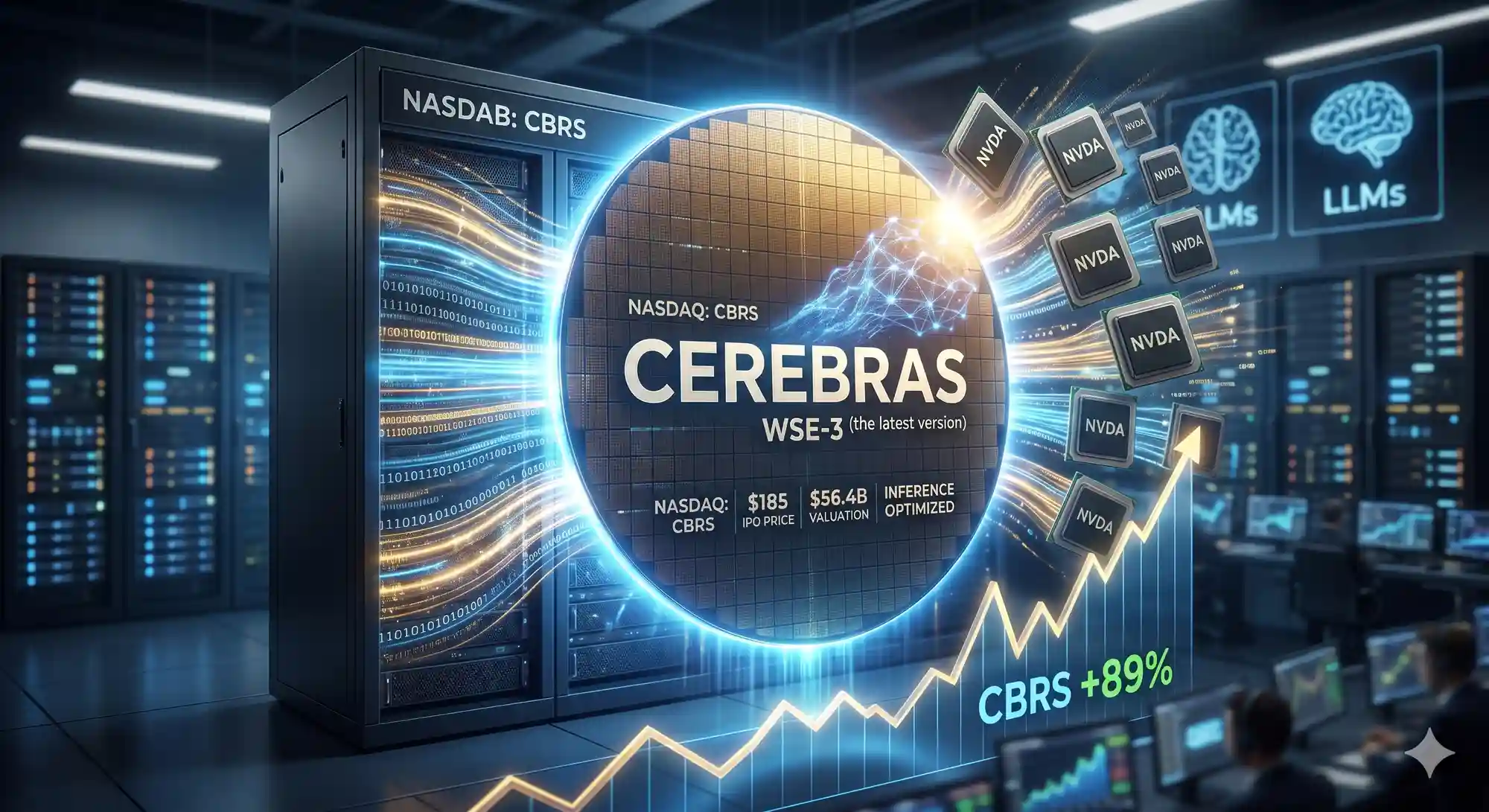
Ultimately, the final Cerebras IPO price was set at $185 per share. This aggressive pricing strategy allowed the company to raise a staggering $5.55 billion in fresh capital.
The offering was reportedly 20 times oversubscribed. Early market indications pointed to a near doubling of the stock price upon the opening bell, with shares surging as much as 89% in early debut projections.
At the $185 IPO price, Cerebras commands a fully diluted valuation of $56.4 billion. This is a massive leap from its $23 billion private valuation recorded during its February 2026 funding round.
Lead underwriters for this historic transaction included Morgan Stanley, Citigroup, Barclays, and UBS.
Deeper Technical Analysis: CBRS vs NVDA AI Chip Architecture
To understand the hype surrounding the Cerebras IPO stock price prediction, one must look closely at the underlying physics of their hardware.
Traditional graphics processing units (GPUs), like those manufactured by Nvidia, are diced from larger silicon wafers into smaller, individual chips. These chips must then be connected via complex networking protocols.
Cerebras takes a radically different engineering approach. They build “wafer-scale” AI chips.
Instead of cutting the silicon into individual pieces, Cerebras utilizes the entire wafer as a single, massive processor. This hardware is known as the Wafer-Scale Engine (WSE).
The technical advantage of the WSE lies in overcoming the “memory wall.” In traditional GPU clusters, moving data between separate chips creates significant latency and consumes massive amounts of power.
Because all the processing cores on a Cerebras chip exist on the same unbroken piece of silicon, data routing happens on-chip. This results in unprecedented memory bandwidth and virtually zero communication bottlenecks.
For massive AI workloads, this architectural shift eliminates the need for thousands of optical transceivers and miles of networking cables.
Why Cerebras AI Chips Stand Out for Inference Workloads
The AI hardware market is currently transitioning from an era of “training” to an era of “deployment” or “inference.”
Training is the computationally intensive process of teaching a massive large language model (LLM) how to behave. Nvidia has built an impenetrable fortress in the training market.
Inference, however, is the process of generating responses when users actually prompt the model. This requires incredible speed and low latency.
Cerebras positions its Wafer-Scale Engine explicitly around these AI inference workloads.
By keeping the entire neural network on a single wafer, Cerebras claims it can achieve throughput speeds up to 15 times higher than comparable GPU-based systems.
As the industry shifts its capital expenditure toward deploying these models to billions of users, the demand for fast, cost-effective inference hardware is skyrocketing.
This macro-level shift from training to inference is a primary driver behind the 20x oversubscription of the CBRS IPO.
Financials and Growth Metrics: Behind the Hype
A hardware startup cannot sustain a $56.4 billion valuation on technical claims alone. Cerebras has delivered the financial growth required to back up its engineering.
According to its SEC filings, Cerebras generated $510 million in revenue for the full year 2025. This represents a massive year-over-year jump from the $290.3 million recorded in 2024.
More importantly, the company proved it could scale efficiently. Cerebras swung to a net income of $237.8 million in 2025.
This profitability is a stark contrast to the $481.6 million net loss the company posted the previous year.
Showing positive net income prior to an IPO is rare for high-growth hardware startups, giving institutional investors confidence in the company’s unit economics.
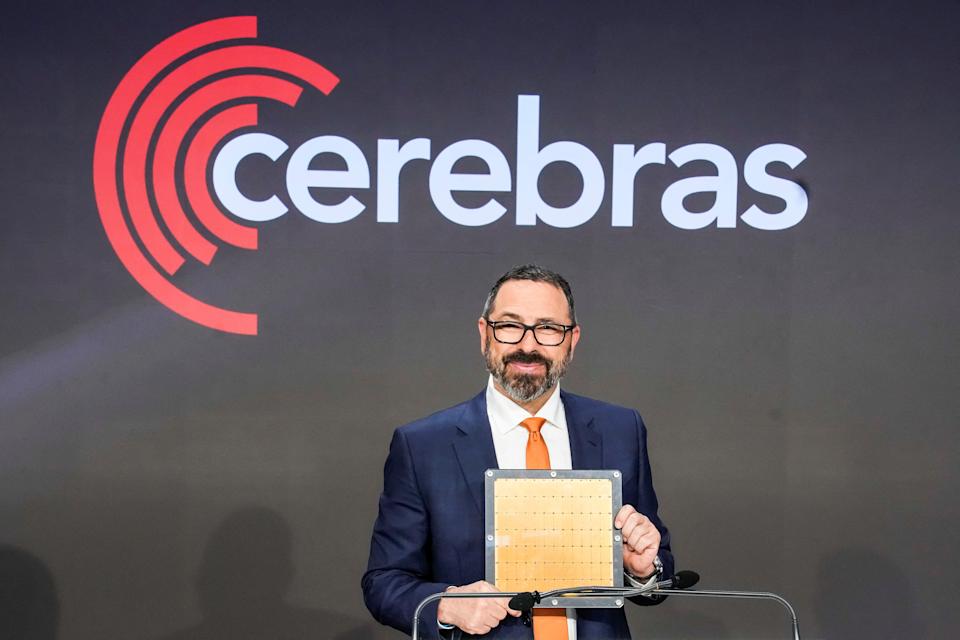
CEO Andrew Feldman, who now holds a stake worth approximately $1.9 billion, has successfully navigated the transition from a cash-burning research lab to a highly profitable enterprise.
Contrasting Viewpoints: The Hidden Risks of CBRS Stock
Despite the euphoric market debut, contrasting viewpoints highlight several distinct risks associated with CBRS stock.
First is the issue of customer concentration. Historical SEC prospectuses have drawn heavy scrutiny over Cerebras’ reliance on a single major customer: a technology entity backed by the UAE’s G42.
If this geopolitical or commercial relationship sours, a massive chunk of Cerebras’ recurring revenue could evaporate overnight.
Second is the software moat. Nvidia does not just sell silicon; it sells CUDA, the deeply entrenched software platform that millions of AI developers rely upon.
Transitioning away from CUDA to a new software ecosystem is a daunting task for data center operators. Cerebras must prove that its software stack is seamless and developer-friendly enough to justify the switch.
Finally, the sheer size of the $56.4 billion valuation leaves very little room for execution error. Any delays in manufacturing or supply chain hiccups could trigger significant volatility.
The Macro Impact: Kick-Starting the 2026 AI IPO Season
The successful debut of Cerebras represents a watershed moment for the broader 2026 technology market.
For months, the IPO pipeline had been building pressure, with investors desperate for new avenues to gain exposure to artificial intelligence.
Cerebras has effectively opened the floodgates. By pricing above the expected range and surging in early trading, CBRS has proven that the market is willing to absorb massive AI offerings.
Analysts are now viewing this event as a precursor to larger potential megadeals expected later this year.
Companies like SpaceX, OpenAI, and Anthropic are all watching the Cerebras debut closely as they evaluate their own potential public listings.
How to Buy Cerebras Shares Today
For retail investors wondering how to buy Cerebras shares today, the process is now straightforward.
Since the stock is officially listed on the Nasdaq Global Select Market, anyone with a standard brokerage account can purchase shares.
Simply log into your trading platform, search for the ticker symbol CBRS, and execute a buy order.
Given the extreme volatility expected in the initial weeks of trading, financial advisors generally recommend using limit orders rather than market orders to control the execution price.
Frequently Asked Questions (FAQ)
What is the Cerebras IPO price?
The company officially priced its initial public offering at $185 per share, aggressively stepping above its revised expected range of $150 to $160.
What is the ticker symbol for Cerebras?
The company trades on the Nasdaq Global Select Market under the ticker symbol CBRS.
How does Cerebras hardware compare to Nvidia?
Cerebras uses a Wafer-Scale Engine (WSE), meaning its processors are built from an entire, uncut silicon wafer. This dramatically reduces latency and memory bottlenecks compared to traditional modular Nvidia GPUs, making it highly efficient for AI inference workloads.
Is Cerebras a profitable company?
Yes. According to recent filings, Cerebras swung to a net income of $237.8 million on $510 million in revenue for the full year 2025, recovering from a net loss in 2024.
What are the primary risks of investing in CBRS stock?
The core risks include high customer concentration (historically relying heavily on UAE-based G42 for revenue) and the challenge of breaking into Nvidia’s deeply entrenched CUDA developer software ecosystem.
Why is the CBRS IPO considered important for the broader market?
Raising $5.55 billion, it is the largest IPO of the year so far and serves as a vital barometer for investor demand. Its massive success is expected to pave the way for other tech giants like OpenAI and SpaceX to go public.